
What is the Thailand LTR Visa?
Thailand’s Long-Term Resident (LTR) visa offers eligible investors, retirees and professionals a stay of up to 10 years. Applicants qualify through one of four categories, each with different income, asset or employment requirements.
This guide explains who qualifies, what documents BOI requires, how property investments are assessed, and the steps from application to visa issuance.
- Length of stay: initially five years, with a further five years subject to eligibility reconfirmation.
- Government visa fee: THB 50,000 per person when issued in Thailand; overseas fees vary.
- Application: online qualification endorsement through BOI, followed by visa issuance.
Thailand LTR Visa Requirements in 2026: Quick Eligibility Table
The principal eligibility routes are summarized below. Detailed requirements and supporting-document rules follow in the relevant sections.
| LTR category | Main requirement |
|---|---|
| Wealthy Global Citizen | USD 1 million in total qualifying assets, including at least USD 500,000 invested in qualifying Thai assets. |
| Wealthy Pensioner | Age 50 or older and either USD 80,000 annual passive income, or USD 40,000 annual passive income plus a USD 250,000 qualifying Thai investment. |
| Work-from-Thailand Professional | Average annual income of USD 80,000 over the previous two years, or at least USD 40,000 with additional qualifying credentials. Employment by an eligible overseas company is also required. |
| Highly Skilled Professional | Qualifying employment or expertise, normally with average annual income of USD 80,000 over the previous two years, or at least USD 40,000 with the required additional qualifications. Income exemptions apply to eligible applicants. |
| Dependents | Under the rules currently in force: a legally recognized spouse and children under 20. Announced wider dependent categories require implementing regulations before they apply. |
Health coverage or a qualifying financial alternative is also required. The financial thresholds alone do not establish eligibility.
Check which LTR category fits your circumstances
Send us your age, employment situation, approximate annual income and any investment you hold or plan to make in Thailand. We can assess the relevant LTR category and explain the supporting documents and next steps.
Who Qualifies? Detailed Requirements by LTR Category
The LTR Visa is available to four groups of eligible foreigners:
1. Wealthy Global Citizens
2. Wealthy Pensioners
3. Work-from-Thailand Professionals
4. Highly Skilled Professionals
Current dependent rule: A legally recognized spouse and children under 20 may apply based on the primary applicant’s eligibility. An expansion to parents and other legal dependents has been announced but is not yet in force; it will apply only after the necessary implementing regulations are issued.
LTR Visa for Wealthy Global Citizens
The Wealthy Global Citizens category is designed for high-net-worth individuals seeking long-term residency in Thailand.
Eligibility Criteria
Applicants must hold total net assets of at least USD 1 million, including assets held both in Thailand and abroad. Of this amount, at least USD 500,000 must be invested in Thailand in one or more of the following:
- Thai government bonds issued by the Ministry of Finance (minimum 5-year maturity).
- Private or commercial real estate in Thailand.
- Direct investment in a Thai limited company or public limited company.
- Investment in a venture capital firm or private equity trust registered with the Securities and Exchange Commission (SEC) of Thailand or approved by the relevant authorities.
Note: Details on qualifying property investments in Thailand are covered in a later section.
How Assets Are Calculated
Qualifying investments in Thailand count toward the USD 1 million total asset requirement. For example, an applicant who invests USD 500,000 in eligible Thai assets needs only USD 500,000 in additional assets elsewhere to meet the threshold.
Accepted Asset Types
Applicants may use one or more of the following to demonstrate their total net worth:
- Bank deposits held in financial institutions.
- Private or commercial real estate.
- Shares in privately held companies.
- Publicly traded stocks and mutual funds.
- Gold held in financial institution accounts.
- Other assessable assets, provided that ownership and valuation can be properly documented.
Excluded assets: Cryptocurrencies, digital tokens, amulets, artwork, designer items, and personal adornments such as watches and jewelry are not eligible.
Required Documents
Applicants must provide verifiable documentation to confirm:
- Total assets — such as bank statements, property deeds, and investment portfolios.
- Investments in Thailand — such as government bond certificates or property ownership records.
For the full and most up-to-date list of required documents, visit the official LTR Visa page.
For a closer look at qualifying assets and supporting evidence, see our LTR visa guide for Wealthy Global Citizens.
LTR Wealthy Pensioner Visa: Age, Passive Income and Investment Requirements
Eligibility Criteria
This category is designed for individuals aged 50 or older with a stable passive income. Applicants must meet one of the following income requirements:
Option A — Annual passive income of at least USD 80,000.
Option B — Annual passive income of at least USD 40,000, combined with a minimum investment of USD 250,000 in Thai government bonds, real estate, or direct investments in Thailand.
Qualifying passive income includes pensions, rental income, dividends, royalties, and interest. Employment income such as wages or self-employment earnings is not accepted.
Required Documents
Applicants must provide documentation to verify:
- Passive income for the preceding 12–24 months.
- Investment in Thailand, if applicable (e.g., government bond certificates or property ownership records).
Note: Details on qualifying property investments in Thailand are covered in a later section.
For the full list of required documents, visit the official LTR Visa page.
LTR Visa for Work-from-Thailand Professionals
The Work-from-Thailand Professionals category is designed for remote professionals employed by established overseas companies. Below are the eligibility criteria and required documents.
Income Requirement
Applicants must meet one of the following income thresholds:
• At least USD 80,000 annually, on average, for the past two years.
• Between USD 40,000 and USD 80,000 annually, on average, for the past two years, if they meet one of the following conditions:
• Holds a master’s degree or higher.
• Owns intellectual property.
• Has received Series A funding of at least USD 1 million for a startup (the startup must have progressed beyond the seed stage and entered the growth phase).
Employment Requirement
Applicants must be employed by one of the following:
- A publicly listed company on any stock exchange.
- A private company that meets both of the following conditions:
- Has been operational for at least three (3) years; and
- Has generated a total revenue of at least USD 50 million over the past three (3) years.
- A subsidiary that is wholly owned by a company that meets the above conditions.
Non-Eligible Employers
Employment does not qualify under this category if the employer is:
• A non-profit organization.
• A government entity.
Required Documents
Applicants must submit supporting documents, including:
• Proof of annual income for the past two years.
• Verification of employment status, such as employment contracts and company financial statements.
• Proof of work experience, including resumes and reference letters.
• Proof of qualifications, such as degrees, intellectual property ownership, or evidence of Series A funding.
For the most up-to-date list of required documents, visit the official LTR Visa page.
LTR Visa for Highly Skilled Professionals
The Highly Skilled Professionals category targets individuals contributing to Thailand’s economic, technological, and educational advancement. Below are the eligibility requirements:
1. Income Requirements
Applicants must meet one of the following income thresholds:
✔ At least $80,000 USD annually for the past two years before applying.
✔ Between $40,000 and $80,000 USD annually, if the applicant meets one of the following conditions:
• Holds a master’s degree or higher in science or technology.
• Possesses specialized expertise relevant to their work in Thailand.
✔ No income requirement for applicants employed by:
• Thai government agencies.
• State higher education institutions, research institutes, or specialized training institutes.
2. Employment Requirements
Applicants must present an employment or service contract with a company in Thailand or a foreign company that has assigned them to work in Thailand. Alternatively, they must provide evidence of employment with:
• A higher education institution,
• A research institute,
• A specialized training institute, or
• A government agency in Thailand.
The work must be in one of the following targeted industries:
1. Automotive Industry
2. Electronics Industry
3. High-Quality Tourism Industry
4. Agriculture, Food, and Biotechnology Industry
5. Transportation and Logistics Industry
6. Automation and Robotics Industry
7. Aviation, Aerospace, and Space Industry
8. Biofuel and Biochemical Industry
9. Petrochemical and Chemical Industry
10. Digital Industry
11. Medical Industry
12. Defense Industry
13. Industries Supporting the Circular Economy, including waste-to-energy production and water resource management.
14. International Business Centers (IBC)
Additionally, professionals working in other industries must have specialized expertise in one of the following areas:
1. Research and development in targeted industries or key technologies such as Biotechnology, Nanotechnology, Advanced Material Technology, and Digital Technology.
2. Teaching in vocational or higher education.
3. Application of artificial intelligence (AI), automation, and robotics in business operations.
4. Development and implementation of digital systems to enhance production and services.
5. Financial and marketing consulting services.
6. Environmental and energy management.
7. Management or consulting in startup incubators, acceleration programs, and innovation ecosystems.
8. Alternative dispute resolution services.
9. Promotion of economic development, trade, and investment through foreign chambers of commerce and international trade organizations.
LTR Visa for Dependents
BOI’s current application website lists legally married spouses and children under 20 as eligible dependents, with a maximum of four dependents per main applicant. Same-sex spouses qualify; unmarried partnerships do not. Wider eligibility has been announced, but applicants should confirm implementation with BOI before relying on it.
Applicants must provide official evidence of family relationships, including marriage certificates for spouses and birth certificates for children.
Check BOI’s current dependent criteria and the official dependent document checklist before applying.
Health Insurance and Bank Deposit Requirements
All LTR Visa applicants must demonstrate health coverage using one of the following options:
Option 1 – Health Insurance
A valid policy with minimum coverage of USD 50,000, including medical treatment in Thailand.
This is the most practical and commonly accepted option.
Option 2 – Social Security Benefits
Proof of government-provided medical benefits that include coverage for treatment in Thailand.
Option 3 – Bank Deposit
A personal bank account showing a consistently maintained balance of:
- USD 100,000 for main applicants
- USD 25,000 for dependents
The funds must have been held for at least 12 consecutive months prior to application.
In our experience, the BOI requires:
- Monthly bank statements covering the full 12-month period– the balance for each month must not fall below the required threshold
- A bank confirmation letter confirming that:– the account is in the applicant’s name– funds are fully accessible– withdrawals of any amount, at any time, and from any location are allowed
Note: This option is subject to strict documentation and interpretation by BOI, and may not be feasible for all applicants. Health insurance remains the most practical route in most cases.
Thailand LTR Visa Property Requirements: Freehold and Leasehold
Eligible freehold and leasehold property
For LTR Visa purposes, the following types of property investments are recognized:
• Freehold Ownership: Condominium units, buildings, or houses, provided the property is registered in the applicant’s name.
• Leasehold Rental: Apartments, houses, or land plots with a lease term of at least 10 years remaining. The lease must list the applicant as the lessee.
Note: Properties owned by corporations are not considered qualifying investments.

Property documents and evidence of payment
Published BOI requirements: The Wealthy Global Citizen checklist distinguishes freehold, leasehold and other property investments. The required documents depend on the investment used in the application.
- Freehold: the Land Department sale and purchase agreement and condominium title deed.
- Leasehold: the registered lease agreement and title deed, with at least 10 years remaining on the lease.
- Other property, such as a villa: the construction agreement showing the purchase value and the construction permit.
For freehold and leasehold, the checklist specifies Land Department copies no older than six months. See the official BOI document checklist for the full requirements.
AIM’s practical preparation checklist: Keep the registered agreement, registration records, receipts and bank transfer evidence together, and reconcile the payment total with the amount claimed as a qualifying investment. These payment records support the application and help answer further BOI requests; the published property checklist above does not list each of them as a universal requirement.
How BOI values the investment
When calculating investments for the LTR visa, the BOI does not consider the market value but the original purchase price stated in the sale and purchase agreement and registered with the Land Department.
The same principle generally applies to overseas real estate declared under the Wealthy Global Citizen category: the calculation is based on the amount shown in the official purchase documents, not on any subsequent increase in value. In theory, an independent valuation report could be accepted in some cases, but we are not aware of any confirmed examples of such practice.
Exchange rates used for eligibility
For LTR Visa eligibility, the Thailand Board of Investment (BOI) converts financial information—including income, assets and investment values—into USD using the official exchange rate currently published by the World Bank.
This rate is used as a reference for eligibility assessment and may differ from commercial bank or prevailing market exchange rates.
Check the current references: BOI exchange-rate guidance and World Bank official exchange-rate data.
Thailand LTR Visa Costs and Processing Time
The government fee for a 10-year multiple-entry LTR visa issued in Thailand is THB 50,000 per person. The same fee applies to each dependant. Fees at Thai embassies and consulates abroad vary by location, so check the relevant mission’s current fee before applying.
Permission to stay is initially granted for five years. To stay for the remaining five years, holders must reconfirm that they meet the eligibility criteria. No additional visa fee is charged for this extension.
Processing time
BOI states that qualification endorsement normally takes 20 working days after complete and valid documents are received. Additional document requests can extend the process. Visa issuance involves further steps after endorsement.
See the BOI application timeline for the stages of review.
How to Apply for the Thailand LTR Visa
Application Submission
• Applicants must complete an online form through the official program website and upload the required documents.
• The Board of Investment (BOI) may request additional documents, which must also be submitted online through the applicant’s account.
Visa Issuance
• Once approved, the applicant has 60 days to schedule an appointment for visa issuance at one of the following locations:
• The One Stop Service Center for Visa and Work Permit, located at the Thailand Investment and Expat Services Center (TIESC), 6th–7th floors, One Bangkok, PARADE Zone, Rama IV Road, Lumphini, Pathum Wan, Bangkok.
• Thai embassies or consulates abroad.
• Applicants may change the location for receiving the visa stamp once their application status shows ‘Qualification Approved’. Dependents must receive their visa at the same location as the main applicant.

Benefits of the Thailand LTR Visa
Extended Residency
- 10-Year Renewable Visa: Granted for an initial 5-year period, with the possibility of a 5-year extension upon meeting the required qualifications.
Streamlined Immigration
- Annual Reporting: Report to Thai Immigration once a year instead of every 90 days.
- Multiple Re-Entry: Travel freely without extra permits.
- Fast-Track Airport Services: Enjoy expedited immigration processing at Thai airports.
Employment Advantages
- Digital Work Permit: Available to Highly Skilled Professionals (mandatory), Wealthy Global Citizens, Wealthy Pensioners, and Dependents. Work-from-Thailand Professionals are not eligible, as this category is restricted to overseas employment.
- Quota Exemption: No need for the 4:1 Thai-to-foreigner employee ratio.
Tax Benefits (explained further below)
- No tax on foreign-sourced income for Wealthy Global Citizens, Wealthy Pensioners, and Work-from-Thailand Professionals.
- Flat 17% personal income tax rate for Highly Skilled Professionals working in Thailand.
Tax Incentives for LTR Visa Holders
The LTR Visa program in Thailand offers significant tax advantages, as outlined in Royal Decree No. 743 (official Thai text) / English translation under the Revenue Code, making it a compelling option for qualified foreigners.
Exemption for Foreign-Sourced Income
LTR Visa holders in the following categories are exempt from Thai personal income tax on foreign-sourced income that is remitted to Thailand:
- Wealthy Global Citizens
- Wealthy Pensioners
- Work-from-Thailand Professionals
This exemption applies to assessable income under Section 40 of the Revenue Code, including:
- Employment income earned abroad
- Business income from activities conducted outside Thailand
- Income derived from assets located overseas
The exemption applies to income from the preceding tax year.
17% Flat Tax Rate for Highly Skilled Professionals
LTR Visa holders in the Highly Skilled Professional category are eligible for a flat personal income tax rate of 17%, significantly lower than Thailand’s progressive tax rates (which go up to 35%).
Key conditions:
- The 17% rate applies only to employment income earned in targeted industries promoted under investment and competitiveness enhancement laws.
- The employer must notify the Revenue Department in accordance with Notification No. 427 to apply the reduced rate.
- The tax must be withheld at 17% by the employer, and the taxpayer must not claim a refund or credit for this amount in their annual tax return.
- The reduced rate becomes effective from the day after the completed form is submitted to the Revenue Department.

Digital Work Permits for LTR Visa Holders
LTR Visa holders working for an entity in Thailand must apply for a digital work permit immediately upon visa issuance or before starting employment.
- Highly Skilled Professionals: Mandatory (a work permit is required).
- Wealthy Global Citizens, Wealthy Pensioners, & Dependents: Permitted (only required if taking local employment).
- Work-from-Thailand Professionals: Not Eligible (restricted to remote work for overseas employers).
Application Process
Applications are submitted through the official LTR system after the visa has been issued. The Department of Employment may issue a digital work permit for up to five years. The actual term is based on the employment period stated in Form WP.46.
The supporting documents normally include:
- Form WP.46, completed and signed by the employer;
- Certificate of Company Registration issued by the Ministry of Commerce within the previous six months;
- Form Bor.Or.Jor.5 (list of shareholders);
- the company’s latest financial statements;
- a list of all foreign employees, their positions and right-to-work status;
- a copy of the applicant’s passport, including the biodata page and LTR Visa stamp;
- relevant business licences, if any; and
- the applicant’s previous work permit, if any.
An employment certificate is mandatory. The authorities may request additional documents depending on the employer and the application.
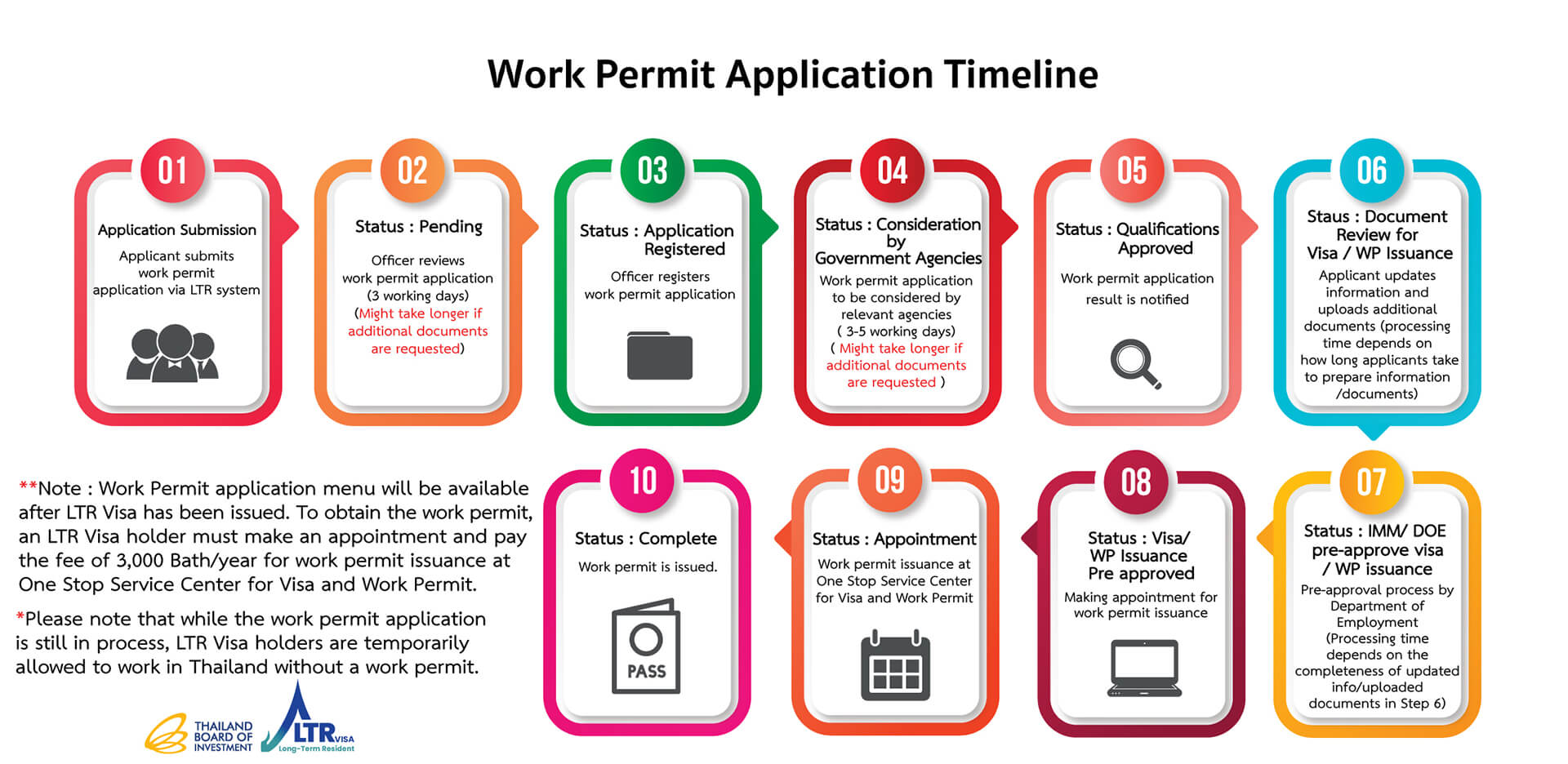
Processing Time and Issuance
Processing normally takes 3–5 working days and may take longer if additional documents are requested. After approval, the applicant makes an appointment with the Department of Employment at the Thailand Investment and Expat Services Center (TIESC), One Bangkok.
Fees
The application fee is THB 100, plus THB 3,000 for each year of the permit. The total therefore depends on the approved term; a five-year permit costs THB 15,100.
Temporary Employment
LTR Visa holders may work temporarily in Thailand while their work permit application is under review.
See the BOI’s official application process overview and detailed visa and digital work permit issuance guidance for current requirements and appointment details.
Thailand LTR Visa FAQs
How long does the LTR Visa application take?
BOI states that qualification endorsement normally takes 20 working days after complete and valid documents are received. Additional document requests can extend the process. Visa issuance involves further steps after endorsement.
Can I apply for the LTR Visa while already in Thailand?
Yes. You can submit your application online through the BOI portal regardless of where you are located. The visa stamp itself can be collected at the One Stop Service Center in Bangkok or as an e-visa at a Thai embassy or consulate abroad.
Do I still need to do 90-day reports on an LTR Visa?
No. LTR Visa holders report to Thai Immigration once a year instead of every 90 days, as long as they remain in Thailand without leaving. Multiple re-entry is also included, so no separate re-entry permit is required.
Can LTR Visa dependents work in Thailand?
Yes. Dependents of LTR Visa holders are eligible to apply for work permits, regardless of which category the primary applicant holds.
Can I include my parents as dependents on my LTR Visa?
BOI’s current application website lists spouses and children under 20 as eligible dependents. Wider eligibility, including parents, has been announced, but applicants should confirm implementation with BOI before relying on it.
What is the difference between the LTR Visa and the Thai Retirement Visa?
The retirement visa requires annual renewal, 90-day reporting, and does not include tax benefits or a digital work permit. The LTR Visa for Wealthy Pensioners offers a 10-year stay, annual reporting, and a full exemption from Thai personal income tax on foreign-sourced income — but requires either USD 80,000 in annual passive income or USD 40,000 combined with a USD 250,000 investment in Thailand.
What is the difference between the LTR Visa and the Destination Thailand Visa (DTV)?
The DTV is a 5-year visa aimed at remote workers and long-stay tourists, with no investment requirement. The LTR Visa offers a longer residency period (10 years), stronger tax benefits, a digital work permit, and annual reporting instead of 90-day reporting — but with stricter income, asset, or employment requirements. The right choice depends on your income level, employment situation, and how long you plan to stay.
What counts as a qualifying investment for the LTR Visa?
Qualifying investments in Thailand include Thai government bonds (minimum 5-year maturity), freehold property registered in your name, direct investment in a Thai limited or public company, and investment in SEC-registered venture capital or private equity funds. Leasehold arrangements qualify if the lease has at least 10 years remaining and lists you as the lessee. Properties held through corporations do not qualify.
How does the BOI value property for LTR Visa purposes?
The BOI uses the original purchase price stated in the sale and purchase agreement registered with the Land Department — not the current market value. Any appreciation in value since purchase does not count toward the investment threshold.
How much does the LTR Visa cost?
The government fee is THB 50,000 per person when the LTR visa is issued in Thailand. Each dependent pays a separate fee. Fees charged by Thai embassies and consulates vary; check the issuing mission before applying. Professional assistance and any work permit charges are separate.
Can I work in Thailand on an LTR Visa?
Wealthy Global Citizens, Wealthy Pensioners, Highly Skilled Professionals and Dependents may apply for a digital work permit after receiving the LTR Visa. Applications are submitted through the LTR system. Work-from-Thailand Professionals are not eligible because that category is intended for remote employment with an overseas employer and does not permit employment with a Thai employer.
Can I convert my existing Thai visa to an LTR Visa?
There is no formal conversion process. You apply for the LTR Visa through the BOI portal from scratch, regardless of what visa you currently hold. Depending on your current visa, it may need to be cancelled prior to receiving the LTR Visa stamp.
What Changed in 2025—and Which Rules Apply in 2026?
In February 2025, the LTR Visa program was officially updated with relaxed requirements and announced changes to dependent eligibility. However, please note that the expanded criteria for dependents—including the inclusion of parents—are not yet in force. These will apply only after the Ministry of Interior and the Immigration Bureau issue the necessary implementing regulations.
Key updates include:
• Removal of the income requirement for applicants in the Wealthy Global Citizens category.
• Announced expansion of dependent eligibility, which will allow more family members to be included under the program — including parents and other legal dependents — once supporting regulations are issued.
• Simplified qualification criteria for Work-from-Thailand Professionals and Highly Skilled Professionals.
For a detailed overview of these changes, refer to our separate post:
Thailand LTR Visa 2025: Lower Income Barriers, Expanded Family Options, and Career Opportunities
Official BOI Sources and Latest LTR Visa Statistics
The Thailand Board of Investment publishes monthly statistics for the Long-Term Resident Visa programme. As of 31 August 2026, the programme had recorded 11,401 successful applicants since its launch on 1 September 2022.
August produced 628 additional approvals, compared with an increase of 300 in July.

Approvals by Category
Wealthy Pensioners remain the largest LTR Visa category, with 4,279 approvals, representing approximately 37.5% of all successful applicants. They are followed by Dependants with 3,693 approvals, High-Skilled Professionals with 1,714, Work-from-Thailand Professionals with 1,024, and Wealthy Global Citizens with 691.
Wealthy Pensioners and Dependants together account for 7,972 approvals, or almost seven in ten successful applicants. These two categories also produced 480 of the 628 additional approvals recorded in August.
For investors and financially independent applicants, the figures confirm that the Wealthy Pensioner and Wealthy Global Citizen routes remain important parts of the LTR programme. Eligibility under these categories depends not only on headline financial thresholds but also on how income, assets and qualifying investments are documented.
Nationality Breakdown
The United States remains the leading nationality with 2,375 successful applicants, followed by Japan with 1,298, the United Kingdom with 1,020, Russia with 875 and Germany with 557.
Applicant profiles vary substantially by country. The US total is driven mainly by Wealthy Pensioners, while Japan has the largest number of High-Skilled Professionals among the individually listed nationalities.
BOI also reports an aggregated “Others” group covering nationalities not listed separately in the infographic.
Data source: Thailand Board of Investment / LTR Visa Office. Figures cover 1 September 2022 to 31 August 2026. Total successful applicants: 11,401.
Need Help with Your LTR Visa Application?
We assess LTR Visa eligibility for investors, high-net-worth applicants and retirees, structure the supporting evidence, and guide the application from BOI submission through visa issuance.
